Translation Gem · Kyojuro Rengoku
Rapid-fire imperatives: VIZ's "KEEP YOUR HEART BURNING, GRIT YOUR TEETH AND MOVE FORWARD"
VIZ transforms three rapid-fire imperatives into a perfectly paced command sequence. The key move: reframing 向け (face forward) as MOVE FORWARD amplifies the original's motivational force, turning directional awareness into unstoppable action.

Japanese (manga)
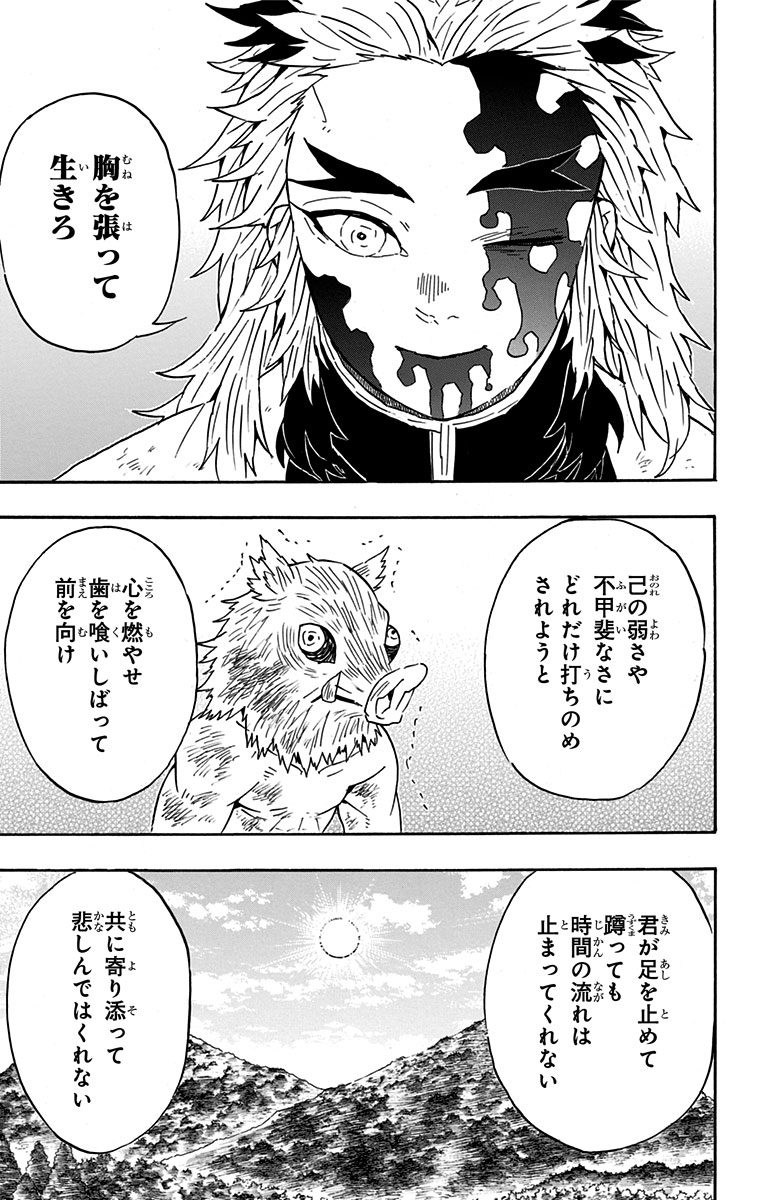
鬼滅の刃 第8巻 p.93 ©吾峠呼世晴/集英社
English (VIZ official)
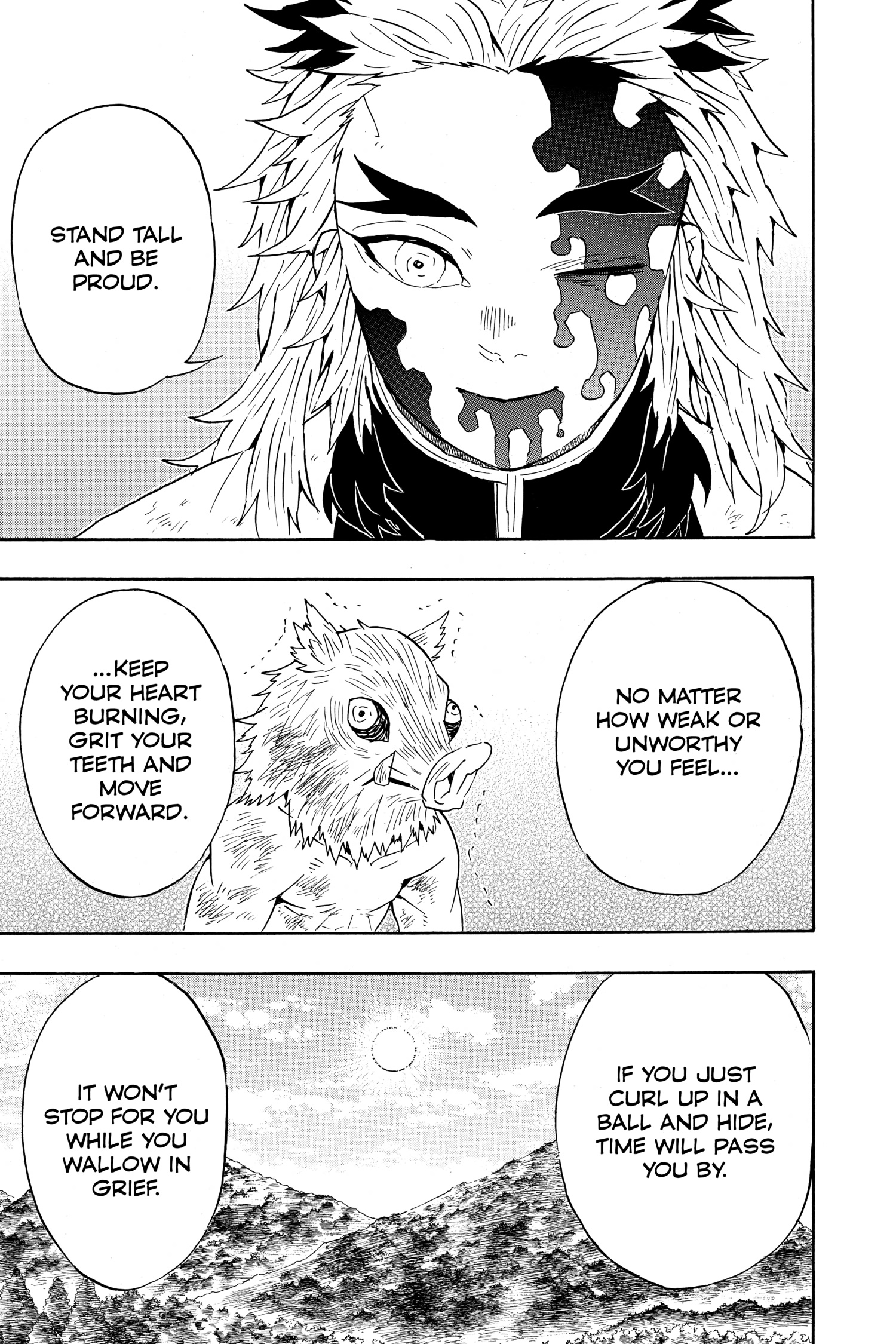
Demon Slayer Vol. 8 (VIZ Media), p.93 ©Koyoharu Gotouge/VIZ Media
Japanese (manga)
心を燃やせ歯を喰いしばって前を向け
Kokoro wo moyase ha wo kuiishibatte mae wo muke.
鬼滅の刃 Vol. 8, p.93
English (VIZ official) — ✓ nails it
"KEEP YOUR HEART BURNING, GRIT YOUR TEETH AND MOVE FORWARD."
Demon Slayer Vol. 8 (VIZ), p.93
Literal meaning
The phrase is structured as three stacked imperatives. The first, 心を燃やせ (kokoro wo moyase), literally means 'set your heart aflame' or 'cause your heart to burn'—where 心 (kokoro, heart) serves as the direct object of 燃やせ, the causative imperative form of 燃える (moeru, to burn). The second, 歯を喰いしばって (ha wo kuiishibatte), means 'gritting your teeth'—where 歯 (ha, teeth) is the object of the gerund 喰いしばって, from 喰いしばる (kuiishibaru, to bite or clench the teeth). The third, 前を向け (mae wo muke), means 'face forward' or 'direct yourself toward the front'—where 前 (mae, front/ahead) is the object of 向け, the imperative of 向ける (mukeru, to face or direct).
Why this translation works
VIZ's rendering preserves the rapid-fire imperative structure that drives the original: three commands stacked in urgent succession, each demanding immediate action. The original's 燃やせ and 向け are both imperatives, and 喰いしばって is a gerund equally commanding in this context—VIZ captures all three with English imperatives (KEEP, GRIT, MOVE), maintaining the forward-pushing, no-nonsense tone. The key rhetorical move is the shift from 向け (directional awareness/facing) to MOVE FORWARD (active progression). While 向け emphasizes knowing which way to face after internal struggle, MOVE FORWARD amplifies the motivational force by adding momentum and volition. This is a felicitous adaptation—the original's implicit "then know which way to face" becomes the more exhortatory "now move forward," better suited to a battle leader's urgent command. The three monosyllabic English verbs (KEEP, GRIT, MOVE) echo the clipped, staccato rhythm of the Japanese, and the all-caps rendering captures the shouted, battle-cry register.
Translation techniques used
VIZ employs **imperative parallelism**, rendering three commands with matching grammatical structure (KEEP, GRIT, MOVE) to preserve the relentless forward drive of the original. The **causative-to-directive reframing** of 燃やせ as 'KEEP...BURNING' transforms the raw imperative 'cause to burn' into an ongoing directive to maintain an internal state—more natural in English exhortation. The **semantic expansion** from 向け (face/orient) to MOVE FORWARD adds forward momentum while amplifying the register. Finally, the three monosyllabic, stress-bearing verbs create **staccato rhythm** that echoes the clipped cadence of the kanji sequence, while **typographic emphasis** (all-caps) signals the shouted, battle-cry intensity.
Register & tone alignment
The original is an urgent, commanding shout with high emotional intensity and physical embodiment. The register is elevated and exhortatory—a mentor or battle leader barking orders with no room for doubt. The emotional register blends grim determination with internal fire. VIZ matches this register point-for-point: the all-caps setting signals shouted urgency, the three monosyllabic verbs maintain the clipped, no-nonsense cadence, and the progression from internal (burning heart) to physical (gritted teeth) to directional (forward motion) preserves the cascade of embodied action. The result is equally commanding, equally high-register, and equally devoid of softening or ambiguity—a perfect tonal match.

Sources
Linguistic analysis grounded in primary sources
- [manga_volume] 鬼滅の刃 Vol. 8, page 93
How this was made: a Japanese Demon Slayer otaku hand-picked the insight from a massive bilingual database pairing every original Japanese line with its official English edition. AI then translated and wrote up the analysis from those source quotes — every Japanese / English excerpt above is a byte-exact capture from the cited manga editions, not invented.