Translation Gem · Kyojuro Rengoku
Why VIZ's 'BLOOMING FLAME UNDULATION' Nails the Poetic Surge of 盛炎のうねり
VIZ elevates a physical attack name by pairing the aesthetic verb 'blooming' with the musicality of 'undulation'—turning a kata description into lyric poetry.

Japanese (manga)
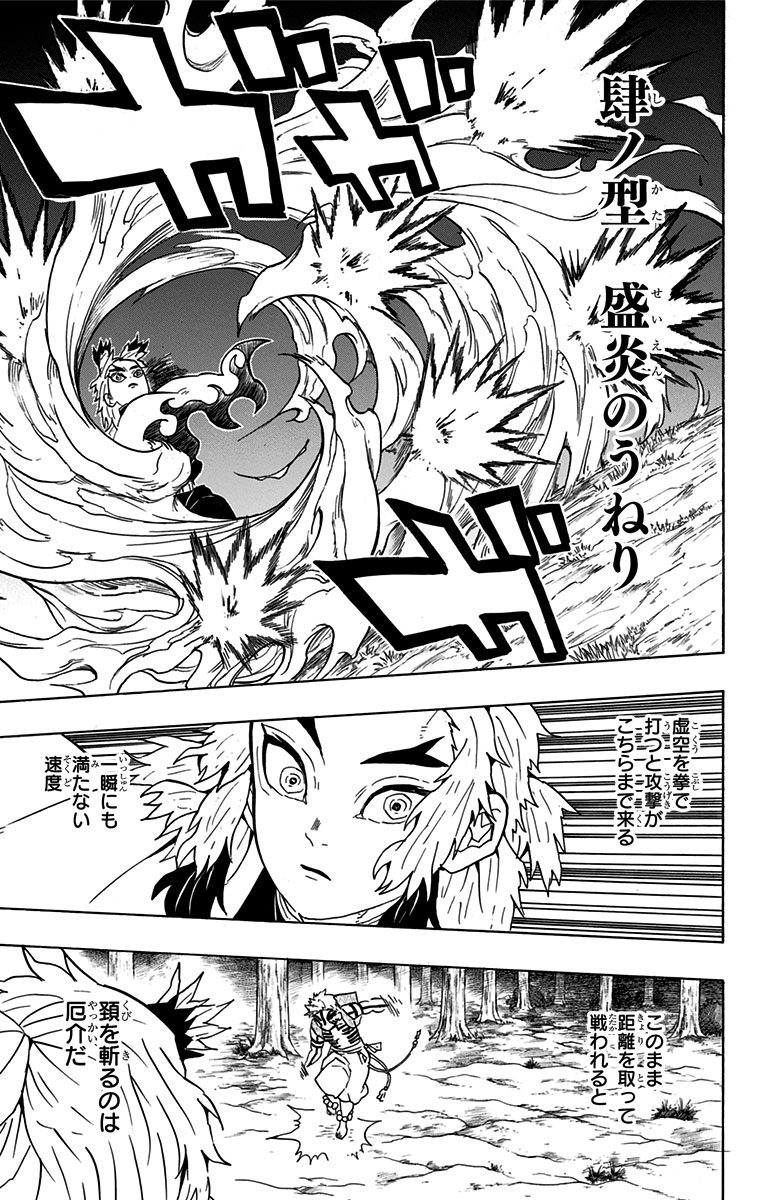
鬼滅の刃 第8巻 p.43 ©吾峠呼世晴/集英社
English (VIZ official)
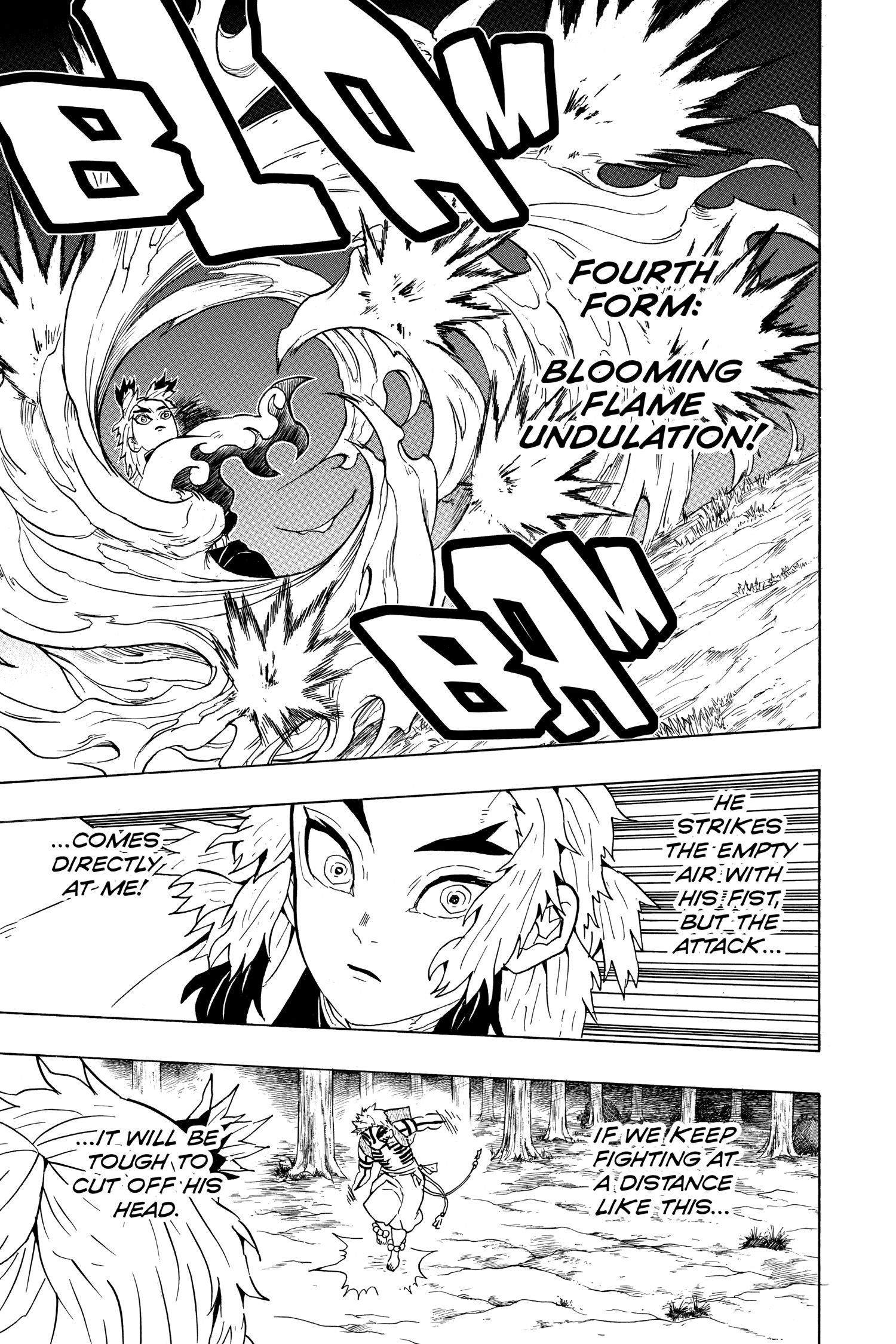
Demon Slayer Vol. 8 (VIZ Media), p.43 ©Koyoharu Gotouge/VIZ Media
Japanese (manga)
炎の呼吸 肆ノ型 盛炎のうねり
Honō no kokyū shi no kata seien no uneri
鬼滅の刃 Vol. 8, p.43
English (VIZ official) — ✓ nails it
"FLAME BREATHING FOURTH FORM: BLOOMING FLAME UNDULATION!"
Demon Slayer Vol. 8 (VIZ), p.43
Literal meaning
The phrase breaks down as 炎 (flame) with the possessive particle の and 呼吸 (breathing/respiration), describing a breathing style. Next, 肆 (four, in formal/kanji numbering) with ノ (archaic genitive particle) and 型 (form/kata) identifies this as the fourth form in the sequence. Finally, 盛炎 (combining 盛 "peak/flourish" with 炎 "flame") possesses うねり (undulation/wave/ripple), naming the attack's motion. Taken literally: "Flame breathing, fourth form: blooming-flame's undulation."
Why this translation works
VIZ's rendering of 盛炎のうねり as "BLOOMING FLAME UNDULATION" succeeds on multiple fronts. 'Blooming' captures both the aesthetic and energetic apex of 盛—not merely "raging" or "surging," but flourishing at peak intensity, lending the attack graceful power. 'Undulation' is a precise, poetic English cognate for うねり, elevating what could be plain 'wave' or 'surge' into something rhythmic and purposeful. The all-caps, colon-separated structure mirrors formal Japanese martial-arts kata naming, maintaining register parity with the source. A flatter rendering—say, 'Flame Breathing Fourth Form: Surging Flame Wave'—would forfeit both the poetic lift and the alliterative music of 'blooming' paired with flame.
Translation techniques used
The translation employs martial-nomenclature register matching (all-caps, formal colon-separation to mirror Japanese kata structure), lexical elevation (choosing 'undulation' over more common 'wave' or 'surge'), and alliterative pairing ('blooming flame') that creates euphonic lift. The rendering of 盛炎 as 'blooming flame' rather than 'raging' or 'surging' re-weights the attack's meaning toward aesthetic peak power rather than raw fury.
Register & tone alignment
Both source and target employ elevated, formal registers befitting martial-arts nomenclature. Japanese uses kanji (盛炎) and archaic particles (ノ) to signal formality and power; VIZ matches with all-caps styling and elevated English diction ('blooming,' 'undulation'). The emotional register is martial and dignified in both languages—respect for the technique's simultaneous beauty and destructive force.

Sources
Linguistic analysis grounded in primary sources
- [manga_volume] 鬼滅の刃 Vol. 8, page 43
How this was made: a Japanese Demon Slayer otaku hand-picked the insight from a massive bilingual database pairing every original Japanese line with its official English edition. AI then translated and wrote up the analysis from those source quotes — every Japanese / English excerpt above is a byte-exact capture from the cited manga editions, not invented.