Translation Pitfall · Kyojuro Rengoku
No Matter the Reason—Why VIZ's 'I Have Reasons' Softens Rengoku's Absolute Resolve
Rengoku's statement asserts absolute will transcending justification—not a reasoned refusal, but a vow that refuses the very premise of capitulation.

Japanese (manga)
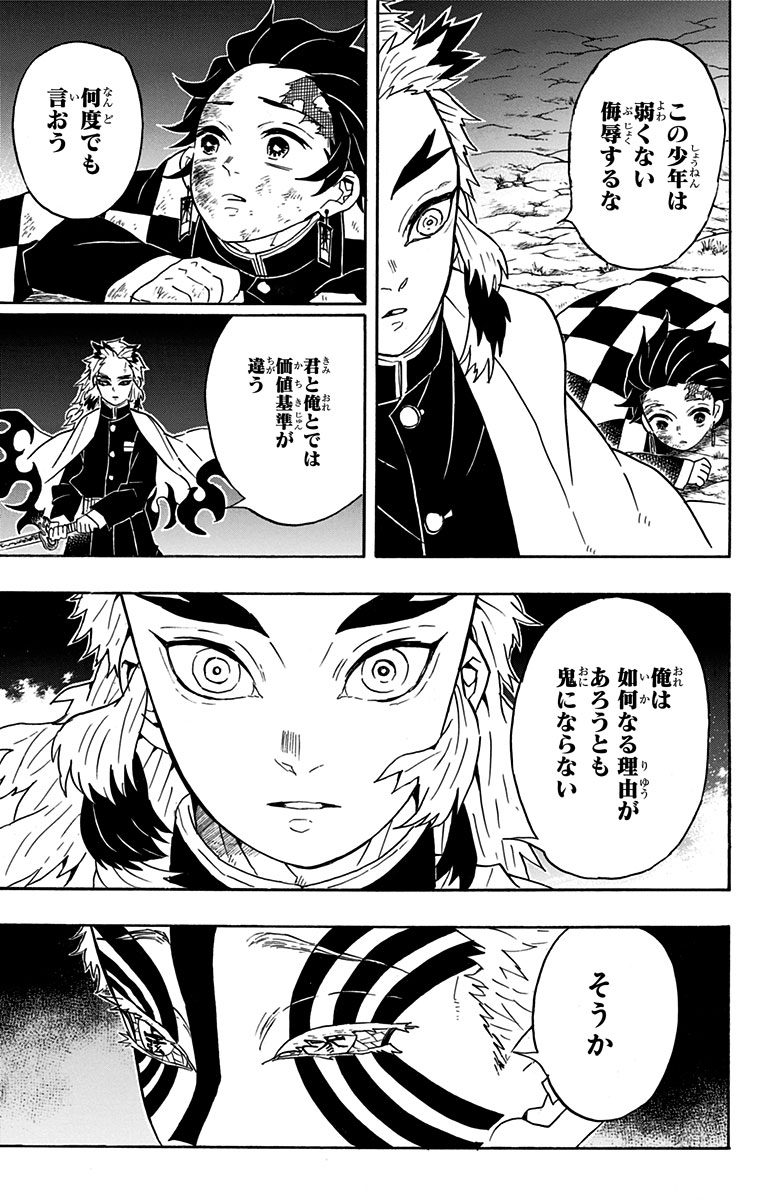
鬼滅の刃 第8巻 p.37 ©吾峠呼世晴/集英社
English (VIZ official)
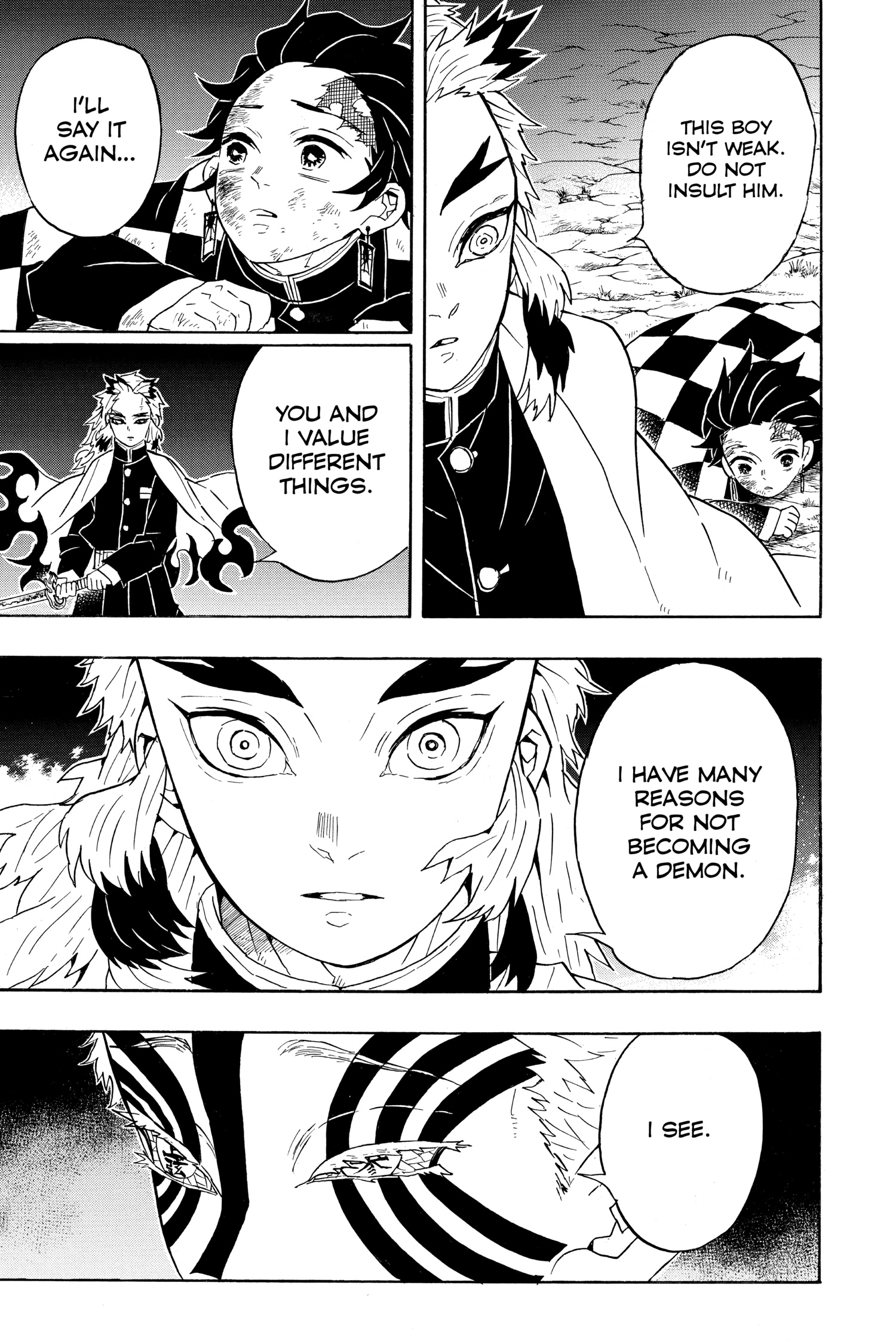
Demon Slayer Vol. 8 (VIZ Media), p.37 ©Koyoharu Gotouge/VIZ Media
Japanese (manga)
俺は如何なる理由があろうとも鬼にならない
Ore wa ika naru riyuu ga arou to mo oni ni naranai
鬼滅の刃 Vol. 8, p.37
English (VIZ official)
"I HAVE MANY REASONS FOR NOT BECOMING A DEMON."
Demon Slayer Vol. 8 (VIZ), p.37
Literal meaning
Word-by-word, the sentence constructs an emphatic personal statement (俺は, 'I, speaking with authority') that preemptively negates a hypothetical condition. The phrase 如何なる理由があろうとも ('no matter what reason might exist') sets up a scenario in which justifications for demonic transformation could theoretically apply. However, the absolute negation in the predicate (鬼にならない, 'will not become a demon') refuses that entire premise. The sentence does not argue for reasons not to become a demon; it categorically denies the possibility regardless of reason—a refusal positioned above the level of rational justification.
Register & tone
The register is distinctly martial and formal, befitting a high-ranking warrior vowing sacred resolve. The speaker uses 俺 (ore), a masculine, assertive first-person pronoun suggesting authority and conviction. The conditional phrase 如何なる理由があろうとも employs classical Japanese grammatical constructions, signaling gravity and finality rather than casual speech. The absence of softening particles (か for question, ね for agreement) renders the statement absolute and binding. The overall tone conveys unshakeable moral commitment—as if the speaker is inscribing a vow that transcends argumentation.
Cultural context
In Japanese, absolute moral stances are often expressed through grammatical structures that acknowledge potential objections while categorically refusing them—a rhetorical pattern found in traditional martial (samurai codes) and religious (Buddhist vow) contexts. The phrase 如何なる理由があろうとも ('no matter what reason') uses a classical conditional construction that presupposes opposing pressures exist, then asserts absolute rejection anyway. This reflects a worldview in which certain moral positions are non-negotiable and exist above rational debate. The underlying logic is not 'I am convinced by argument' but rather 'I am vowed to refuse, period.' In Demon Slayer's context, this principle is the refusal to abandon humanity—an unconditional commitment reflecting Japanese cultural emphasis on integrity as binding duty rather than reasoned choice.

Why the English version misses the mark
VIZ's rendering—'I HAVE MANY REASONS FOR NOT BECOMING A DEMON'—inverts the original logic by reframing it as a reasoned position. The Japanese does not claim to possess justifications; it asserts absolute refusal that supersedes justification. By saying 'I have reasons,' VIZ softens the statement to 'I am rationally convinced not to become a demon,' which is philosophically weaker—a difference between 'I argued myself out of it' versus 'I vowed never to do it.' The conditional structure (如何なる理由があろうとも) is also flattened; the original presupposes reasons might theoretically exist, then negates the conclusion anyway—a deeper assertion of will. VIZ's quantitative 'MANY REASONS' introduces specificity absent from the Japanese, which remains abstract and universal. The emphatic negation and literary register are lost, sacrificing the gravity of a binding vow.
Alternative translations
- I will not become a demon, no matter what reason might compel me. (Preserves conditional-then-negation structure)
- However many reasons there might be, I will not become a demon. (Emphasizes transcending rational arguments)
- No matter the temptation, no matter the justification—I refuse to become a demon. (Stresses volitional refusal over rational defense)
- I am one who shall never become a demon, reason notwithstanding. (Emphasizes identity and absolute nature of the vow)
- Let there be any reason you will—I shall not become a demon. (Archaic register matching the original's gravity)

Sources
Linguistic analysis grounded in primary sources
- [manga_volume] 鬼滅の刃 Vol. 8, page 37
How this was made: a Japanese Demon Slayer otaku hand-picked the insight from a massive bilingual database pairing every original Japanese line with its official English edition. AI then translated and wrote up the analysis from those source quotes — every Japanese / English excerpt above is a byte-exact capture from the cited manga editions, not invented.